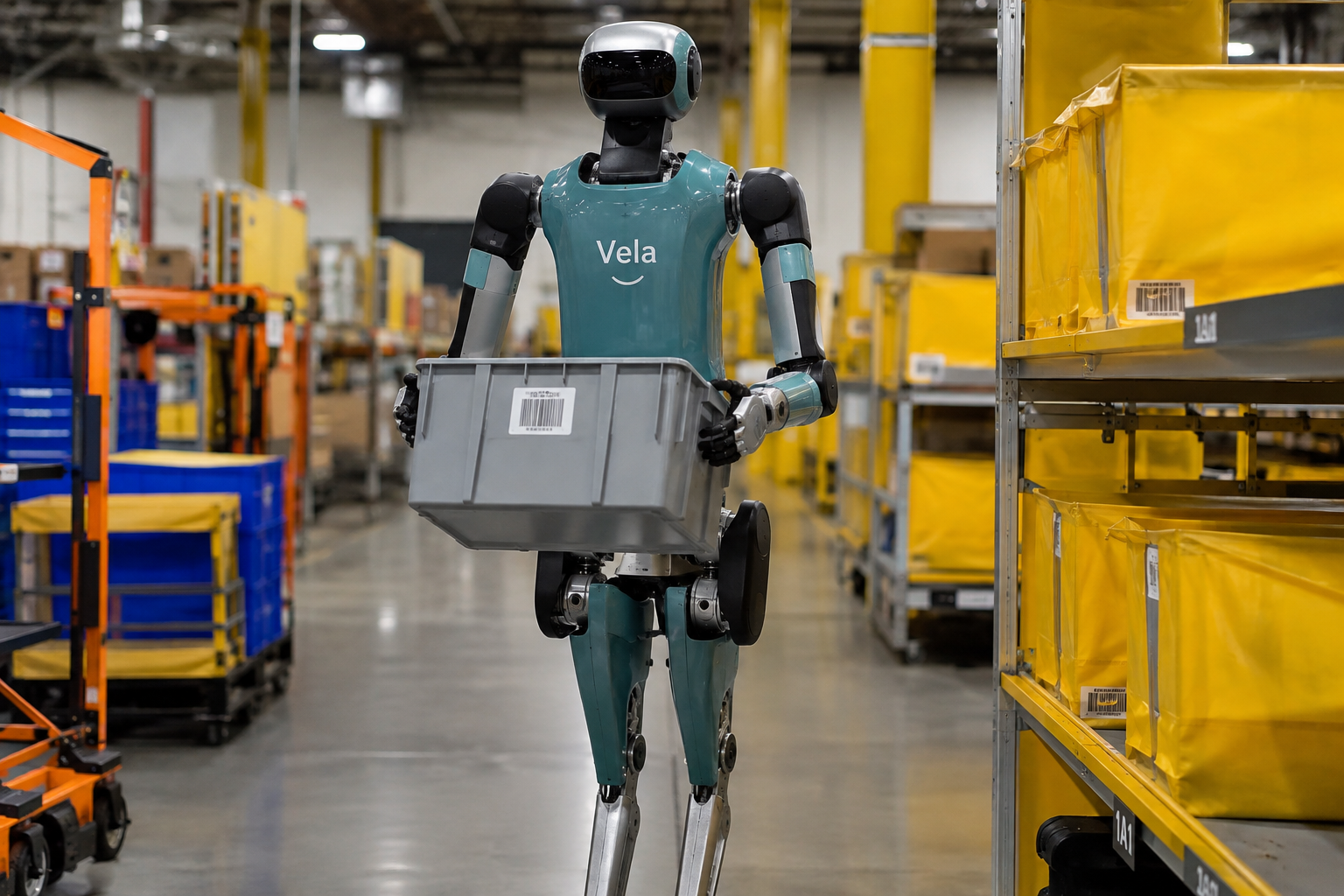
Amazon has officially introduced Vela, a new generation of humanoid robots built to work in environments originally designed for people.
The robot stands on two legs and features two articulated arms, hands capable of handling everyday objects, advanced cameras and a network of sensors that allow it to understand its surroundings and interact with physical spaces.
Amazon says Vela has been designed as a general-purpose robot rather than a machine built around a single task.
The first Vela units will be deployed across Amazon fulfillment centers, where they will assist with moving packages, transporting containers, sorting products, loading inventory and completing repetitive physical tasks.
Vela can receive instructions through Amazon's AI systems and determine how to complete a task without requiring every individual movement to be programmed in advance.
For example, a worker could instruct Vela to collect a specific container from another section of a warehouse and bring it to a workstation. The robot can identify the container, calculate a route through the facility, avoid people and obstacles, pick up the object and deliver it autonomously.
Amazon has spent more than a decade building one of the world's largest industrial robotics networks. The company already operates hundreds of thousands of robotic systems across its logistics infrastructure, but most of those machines have been designed for specific warehouse functions.
Vela represents a different approach.
Instead of adapting buildings around robots, Amazon wants Vela to operate inside spaces that already exist.
Its humanoid form allows it to walk through standard doors, use existing tools, carry objects between floors and interact with equipment designed for human workers.
The company has also developed a new physical AI system specifically for Vela. The system combines visual understanding, language processing and real-world movement, allowing the robot to learn new tasks from demonstrations and verbal instructions.
Amazon says multiple Vela robots can also share what they learn.
When one robot develops a more efficient method for completing a task, that information can be distributed to other Vela units through Amazon Web Services.
The company plans to begin with controlled deployments inside its logistics network before expanding Vela into manufacturing, retail and commercial environments.
Future versions are also being developed for consumer use.
Amazon believes humanoid robots could eventually become a new computing platform, performing physical tasks in the same way computers and AI assistants currently perform digital ones.
The launch places Amazon in direct competition with Tesla's Optimus program and a growing number of robotics companies attempting to build scalable humanoid systems.
The difference is that Amazon already has an enormous network of warehouses, logistics facilities and delivery operations where the technology can be tested at scale.
Vela will begin operating at selected Amazon facilities later this year, with broader deployments planned for 2027.