US President Donald Trump announced a broad new tariff programme covering imports from most countries, setting a minimum rate of 10% and higher levies for several major trading partners. The baseline measure was scheduled to begin on 5 April, with the steeper country-specific rates due to follow on 9 April.
The announcement quickly unsettled financial markets. The Dow Jones Industrial Average, Nasdaq and S&P fell sharply, producing Wall Street's largest one-day losses since 2020, according to BBC reporting. Trump said markets would eventually boom under the plan, while the White House urged investors to trust the president.
The rates varied widely. The BBC account said goods from India would face tariffs of up to 27%, while it listed rates of 54% for China, 46% for Vietnam, 36% for Thailand, 37% for Bangladesh and 32% for Taiwan. The 10% minimum also applied to the United Kingdom. These differences raised immediate questions about how global manufacturers might reorganise production and sourcing.
Trading partners began mapping out responses. Canadian Prime Minister Mark Carney announced 25% tariffs on certain vehicles imported from the United States. Mexico's President Claudia Sheinbaum said her government would not answer with equivalent measures. The United Kingdom prepared a 400-page sample list of American products that could be targeted if it chose to retaliate, while European Union leaders criticised the US action without yet presenting a formal bloc-wide response.
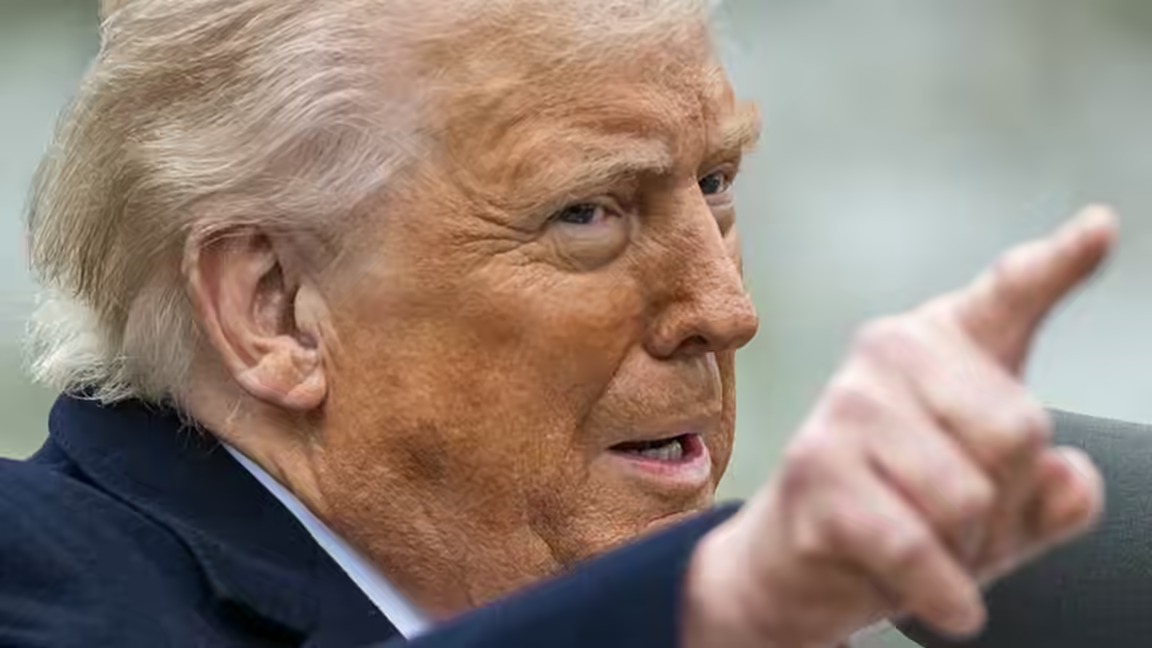
Trump framed domestic production as the route around the levies. Speaking to reporters after the announcement, he said companies could avoid tariffs by building plants or making products in the United States. He acknowledged there would be a transition period and claimed automakers were already shifting some parts production from Mexico and Canada into the US.
For businesses, the more immediate issue was cost. An Italian olive-oil producer told the BBC that a US importer had become hesitant about placing further orders because higher charges could force an increase in consumer prices. In Asia, analysts considered whether the relative rates might redirect orders among competing exporters in sectors including textiles, electronics and machinery.
The package therefore opened two parallel periods of uncertainty: one over the economic effect of a higher US import barrier, and another over retaliation. Market declines reflected that uncertainty, while governments' differing initial responses showed that the eventual trade impact would depend not only on Washington's schedule but also on decisions taken abroad. The range of country-specific rates also meant competitors in the same industry could face very different conditions when selling into the American market. Businesses therefore had to assess both direct charges and potential changes in supplier relationships.