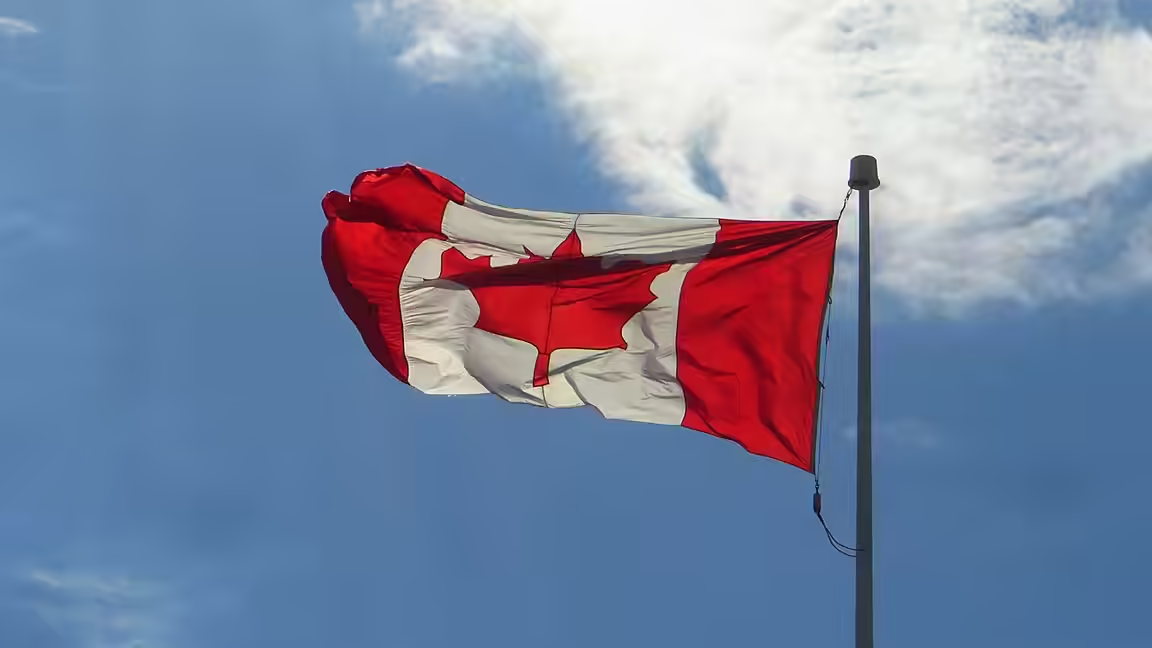
European Commission President Ursula von der Leyen has backed the idea of making Canada the European Union's first associate member, offering political support for a relationship that neither side has yet defined in legal or institutional terms.
Speaking to the European Parliament on September 16, von der Leyen said she wanted to work on opening such a door for Canada. Prime Minister Mark Carney attended the address in Strasbourg and was scheduled to speak to lawmakers the following day. Carney had called for a unique alliance with the EU the previous week.
Von der Leyen identified manufacturing, technology, artificial intelligence, defence, energy, critical minerals and economic security as possible areas for deeper cooperation. She framed the proposal as a strategic partnership grounded in shared positions on democracy, Ukraine, supply chains and climate policy, rather than an arrangement directed against another country.
The initiative comes as Canada's relationship with the United States has deteriorated. Trade talks collapsed last month and were followed by new tariffs, while US President Donald Trump's repeated references to Canada as a possible 51st state have added to tensions. European governments, meanwhile, have faced their own disputes with Washington over tariffs, security policy and threats concerning Greenland, an autonomous territory of EU member Denmark.
Associate membership is not an existing category in EU treaties or enlargement practice. Von der Leyen gave no detailed account of the rights, obligations or decision-making role Canada might receive. Creating the status could take years and would require agreement among member states. Germany's Chancellor Friedrich Merz previously floated a similar concept for Ukraine, but it received a mixed response.
There are also less ambitious routes to stronger cooperation. Canada and the EU already have trade and defence ties, and some European capitals may prefer to expand those structures. Ten of the EU's 27 members have still not ratified the trade agreement reached with Ottawa nearly a decade ago, illustrating the political work required even under established frameworks.
The Canada proposal formed part of a broader security agenda in von der Leyen's annual address. She also proposed a European Security Council that could involve Canada, Norway, Ukraine and the United Kingdom. Such a body could provide an emergency consultation mechanism alongside NATO, though some governments worry that it might duplicate the alliance.
For now, the associate-member concept is an invitation to negotiate rather than a membership offer with settled terms. Its significance lies in the EU leadership's willingness to consider a new institutional category for a close non-European partner at a moment of shifting transatlantic relations.