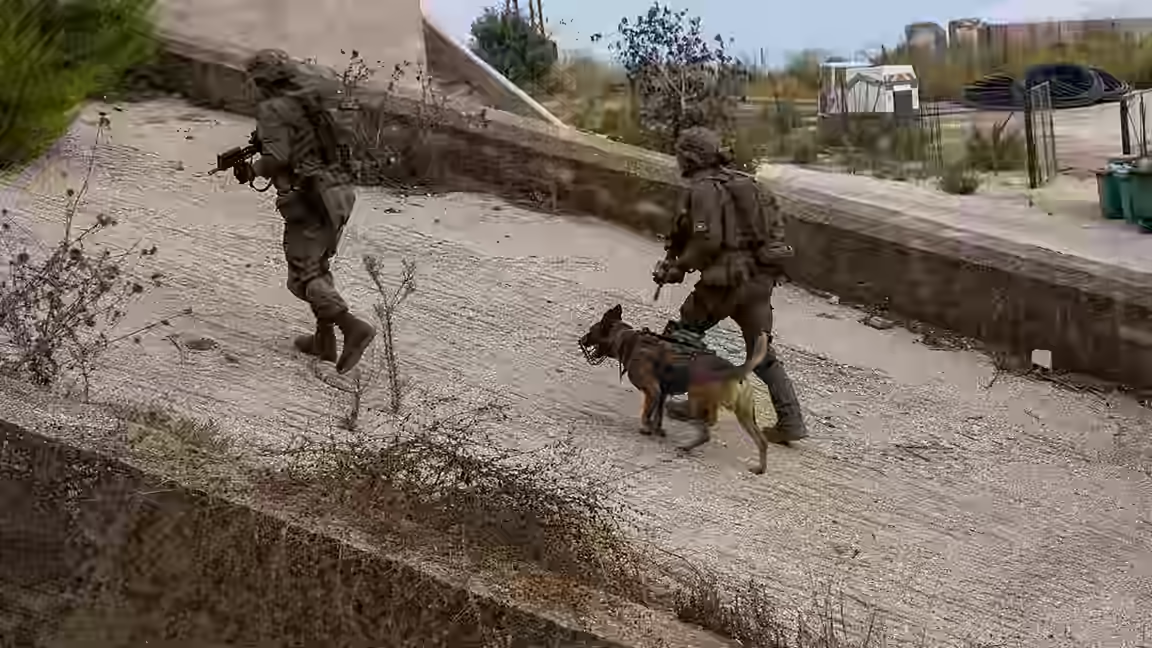
Israeli forces have crossed into southern Lebanon in what the IDF describes as a ground operation aimed at creating a forward security posture for communities in northern Israel.
The 7 Israel report says IDF forces took up forward positions in Lebanese territory and were operating near the border as part of an “enhanced forward defense posture.” The announcement framed the move as a way to provide an additional layer of security for residents of northern Israel. It also said the forces were taking control of multiple positions.
The source excerpt is brief, but it shows a significant step across a tense frontier. Even without a full order of battle, the language points to an operation that is not merely defensive in the narrow sense of staying behind the border fence. The IDF’s own statement, as quoted, suggests active positioning inside Lebanese territory.
The report does not specify whether the operation was linked to a single incident, a broader exchange of fire or a wider campaign. It also does not give casualty figures, describe any Lebanese response or explain how long the troops expected to remain in place. Those omissions matter because ground incursions can range from short tactical moves to more sustained operations.
What the source does establish is the IDF’s stated objective: to create “an additional layer of security” for the north. That wording suggests the operation was being presented to domestic audiences as a protective measure, not as a territorial seizure. The report also names the operation “Roaring Lion,” indicating that the military is placing it within a larger named campaign.
The geopolitical significance is obvious even from the bare source excerpt. Crossing into Lebanese territory carries a high risk of escalation, particularly in a border area that has already seen repeated exchanges and militarized responses. But because the supplied evidence is limited to the IDF statement reported by 7 Israel, this article does not speculate about broader regional consequences or the reactions of Beirut, Hezbollah or international mediators.
In short, the verified point is straightforward: the Israeli military said it had launched a ground operation in Lebanon and was moving forces into southern territory to create a more advanced defensive position. Everything beyond that would require additional evidence not included in the packet.
Military movements across a border can be justified as temporary security measures while still carrying the risks of escalation. The IDF statement quoted here frames the move as defensive, but the fact that soldiers were positioned inside Lebanese territory shows how porous and unstable the frontier remains.
The route disruption matters because it turns a battlefield episode into a civilian logistics problem as well. If a key road linking Beirut to the south is severed, that affects movement of people, goods and medical access. The source does not quantify the length of the closure, but even a temporary cut can have wider effects.
The IDF’s explanation also matters because it shows the operation was presented as part of a protective doctrine rather than a stand-alone incursion. Whether that argument is accepted by Lebanese authorities is a separate question, and the source excerpt does not answer it. For now, the verified news is the crossing, the positions taken and the immediate security rationale offered by the Israeli military.