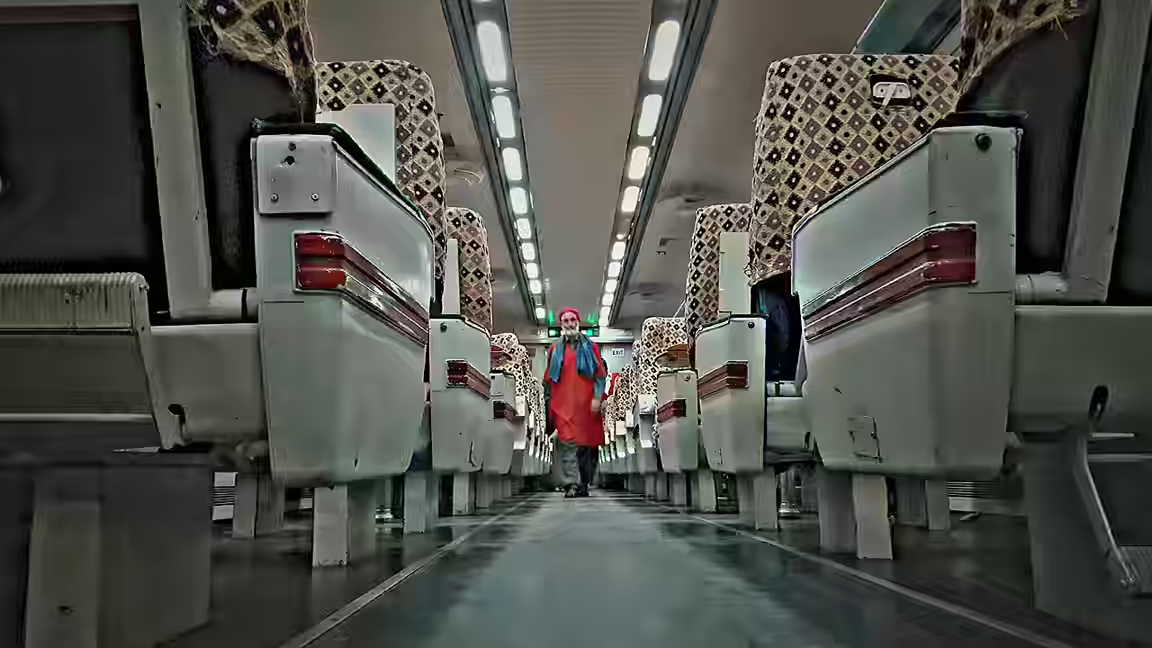
An express train collided with another passenger train in southern Czech Republic, leaving dozens of people injured and prompting an immediate emergency response near České Budějovice.
The AP report in the packet says at least 57 people were hurt and that five of them were seriously injured. The crash happened on the line between Zliv and Dívčice in the České Budějovice region. Those details matter because they place the collision on an active regional rail line rather than in a station yard, suggesting the trains were operating in normal service when the impact occurred.
The evidence does not identify the exact cause of the collision. Authorities were investigating, and the supplied reporting stays within that boundary. That restraint is important in a rail accident, where early speculation can quickly outpace confirmed facts. What is clear is that a passenger train and an express train met with enough force to injure scores of travelers and require a response large enough to treat the scene as a major incident.
The report does not provide a full breakdown of the injuries beyond the count of five serious cases. It also does not say whether there were fatalities, and the packet should be read carefully on that point: it confirms injuries, not deaths. The absence of a death toll in the supplied evidence is not proof that nobody died, but it is the only verified basis available here.
Rail collisions of this kind can shut down lines, strand commuters and complicate wider transport across a region. Even without a final cause, the collision near České Budějovice would have affected local movement and emergency access. In a corridor where passenger trains and express services share infrastructure, safety systems, signaling and human oversight all become part of the inquiry.
The AP account also frames the event as part of a wider pattern in which high-speed or priority rail services can collide with other traffic when something goes wrong in coordination. But the packet does not specify whether this crash involved signaling failure, operator error or another issue, so any conclusion would be premature.
For the people aboard the trains, the immediate story was not about transport policy or infrastructure maintenance. It was about impact, injuries and the urgent work of rescue crews at the scene. For authorities, the task now is to determine how two trains ended up on a collision course and whether the system failed at a technical or human level.
What the evidence firmly supports is the scale of the harm: dozens injured, five seriously, in one of the more significant rail accidents reported in the region this year. The next stage belongs to investigators, who will need to reconstruct the sequence before any broader conclusions can be drawn.