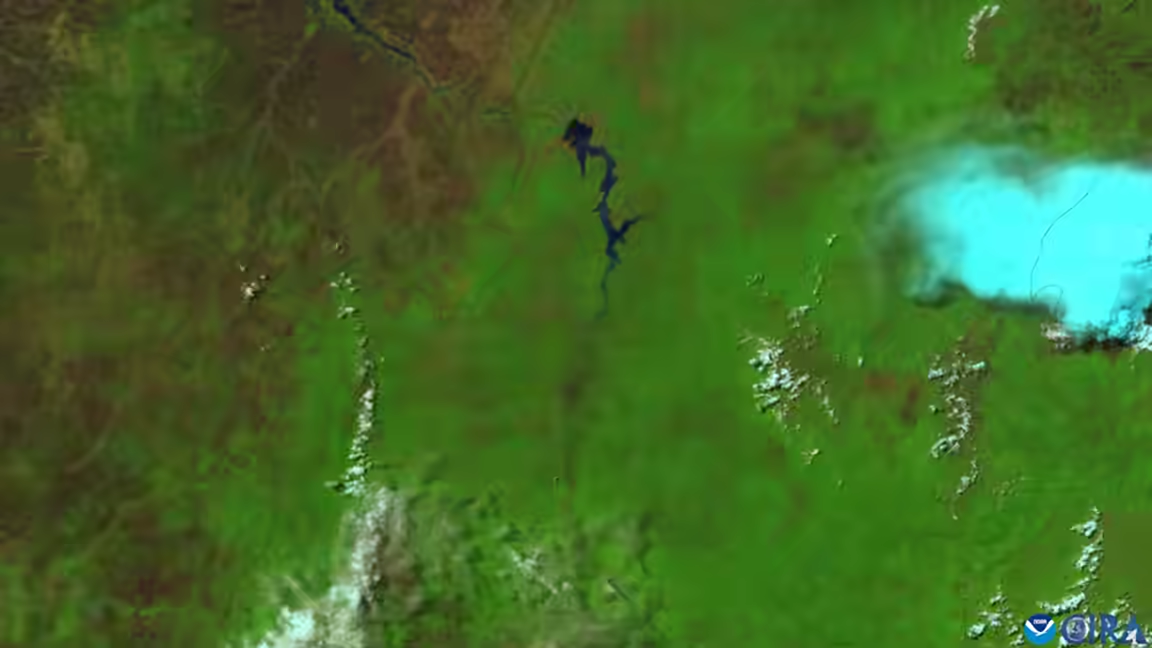
Ethiopia formally launched the Grand Ethiopian Renaissance Dam, a $4 billion hydroelectric project on the Blue Nile designed to generate 5,000 megawatts of electricity. The dam is the largest in Africa by power capacity, though it remains outside the 10 largest globally.
The structure rises 145 metres (476 feet) and extends nearly two kilometres (1.2 miles) across the river close to the Sudanese border. Its reservoir is designed to hold 74 billion cubic metres of water. Construction began in 2011, making the inauguration the culmination of a project pursued for well over a decade.
Prime Minister Abiy Ahmed toured the site during the launch with Kenyan President William Ruto, Somali President Hassan Sheikh Mohamud and African Union Commission chair Mahmoud Ali Youssouf. Celebrations began the previous evening with lanterns, lasers and drone displays carrying slogans that presented the dam as a step toward geopolitical and economic advancement.
Ethiopia plans to use the electricity to expand domestic access and export surplus power across regional connections reaching as far as Tanzania. About 45% of the country's 130 million people lack electricity, according to World Bank data, while blackouts in Addis Ababa require businesses and households to rely on generators. Analysts have argued that additional supply could support industrial production and greater use of electric vehicles.
The project has also deepened a long-running dispute with downstream countries. Egypt relies on the Nile for 97% of its water and receives little rainfall. President Abdel Fattah el-Sissi has called the dam an existential threat and said Egypt would use measures allowed under international law to protect its water security.
Sudan has also raised concern about lower flows. Egypt has strengthened relations with Eritrea and Somalia, both of which have had difficult ties with Ethiopia, and has coordinated closely with Sudan. Efforts by the United States, World Bank, Russia, the United Arab Emirates and African Union to mediate the dispute failed to produce a settlement over the previous decade.
For Ethiopia, the dam has served as a national undertaking and a unifying symbol despite continuing domestic conflicts. Its generating capacity is more than twice the country's existing capacity, making the project's promised economic impact unusually large. For Egypt and Sudan, however, the inauguration did not resolve questions over management of the Blue Nile and the effect of the reservoir on water availability.
The launch therefore marked the dam's full entry into Ethiopia's power strategy while leaving the regional water-security conflict intact.
That unresolved balance between expanded electricity generation and downstream water dependence remained the central regional issue after the inauguration ceremony ended.