# Medical helicopter crash in Japan kills three after sea rescue operation
Three people died when a medical transport helicopter went into the sea off southwestern Japan, while three others were rescued.
By NeoTechNews Desk
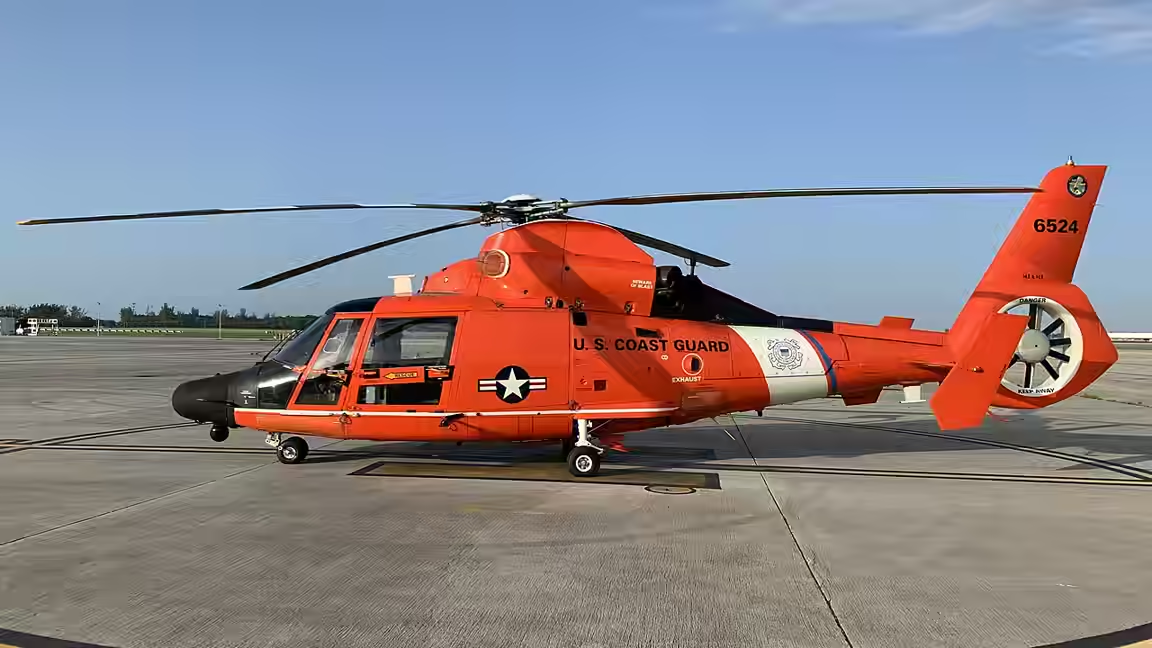
A medical transport helicopter crashed into the sea in southwestern Japan, killing three people and triggering a rescue operation that pulled three survivors from the water. The aircraft was traveling toward a hospital in Fukuoka from an airport in Nagasaki prefecture when it went down in the Tsushima Strait.
The AP report says the helicopter was carrying six people. The pilot, Hiroshi Hamada, the helicopter mechanic Kazuto Yoshitake and a 28-year-old nurse, Sakura Kunitake, were rescued by the coast guard after being found clinging to inflatable lifesavers. All three suffered hypothermia but were conscious. The bodies of the remaining three onboard — doctor Kei Arakawa, patient Mitsuki Motoishi and her caretaker Kazuyoshi Motoishi — were later recovered by a Japan Air Self-Defense Force helicopter.
The sequence matters because it shows both the speed of the emergency response and the partial success of the rescue effort. The coast guard deployed two planes and three ships, and later recovered the missing victims after the initial search. The cause of the crash was still under investigation in the supplied AP report, so it would be wrong to suggest why the helicopter entered the water.
What the evidence does support is a grim but clear outcome: a medical flight became a fatal sea crash, three people survived and three died. The report also makes clear that the victims were not passengers on a leisure trip but part of a medical transport mission, which heightens the shock. Such flights are typically urgent and tightly coordinated, and the loss of the aircraft in open water created a difficult rescue environment even with multiple coast guard assets involved.
The broader significance lies in the combination of emergency medicine and aviation risk. A flight intended to move a patient to care ended in tragedy before it reached its destination. The verified facts are limited but strong: a helicopter crashed into the sea, three crew or medical staff were rescued, three others died, and investigators were still working to explain the accident.
The rescue response involved both coast guard assets and a Japan Air Self-Defense Force helicopter, showing how quickly multiple agencies had to converge on a small and dangerous search area. The fact that the survivors were found clinging to inflatable lifesavers is a reminder that even a partial rescue at sea can depend on simple flotation and fast detection.
The crash also linked a patient transfer to a broader risk environment that air medical crews know well: long routes, weather exposure and water recovery challenges. The supplied evidence does not explain the cause, and that restraint should be preserved. But it does show that the mission ended before the patient reached care, leaving the crash as both an aviation event and a medical-system tragedy.
Because the helicopter was carrying medical personnel and a patient, the crash closed off not just an aviation incident but also a transfer of care. The evidence says nothing about fault, so the responsible account is to leave the cause open and report only what the rescue teams and coast guard confirmed.