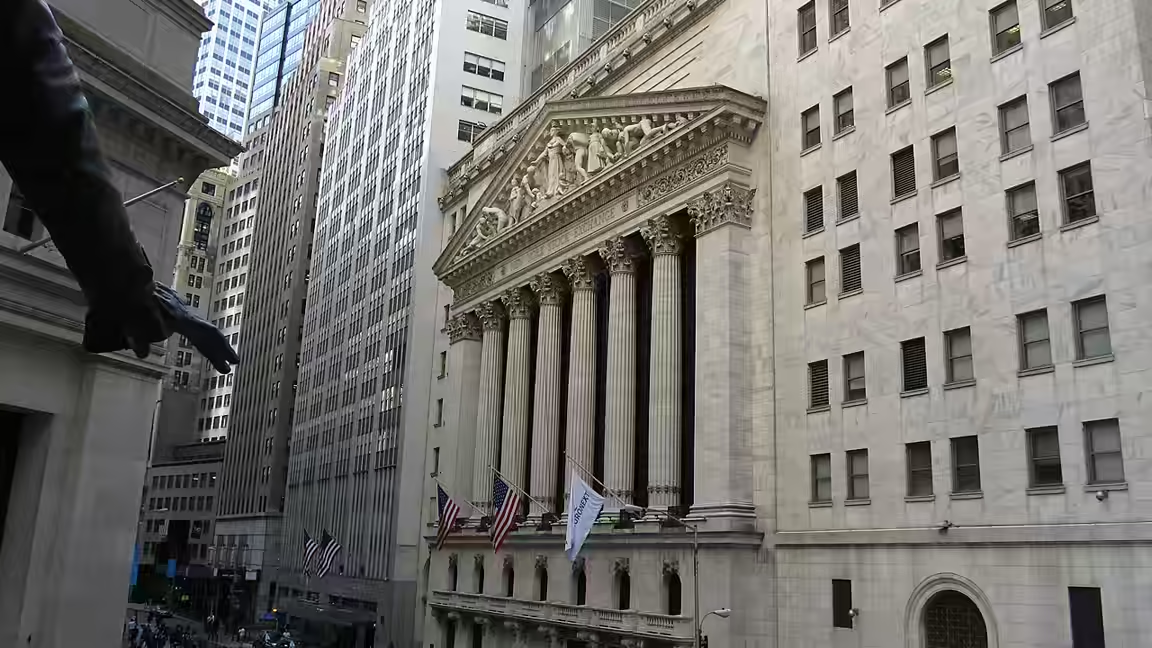
Wall Street spent a second straight day selling off as investors digested Donald Trump’s tariff announcement and the risk it could ripple through trade, prices and corporate profits. The move hit US indexes hard, pushed the Nasdaq Composite into bear-market territory and added to a global rout that also dragged down Europe’s major benchmarks.
According to The Guardian’s live report, all three major US indexes fell more than 5% on the day covered by the update. The Nasdaq closed over 20% below its most recent peak, formally entering a bear market. The Dow was down more than 2,000 points at one stage and the S&P 500 and Nasdaq were each tracking steep losses after a bruising stretch that followed the tariff announcement.
The scale of the fall mattered as much as the direction. The Guardian cited a Dow Jones Market Data estimate that roughly $6.4tn had been wiped from the US stock market across two days. That is not a policy outcome in itself, but it is a sign of how quickly investors reassessed the earnings outlook for companies exposed to global supply chains, imported components and consumer demand.
The tariffs also immediately reached into the real economy. Carmakers Stellantis and Hyundai said they would try to cushion customers from price pressure linked to the 25% tariffs on cars and auto parts. Stellantis said it would offer employee-style pricing, while Hyundai said it would keep prices steady until June 2. Those steps suggested businesses expected customers to start worrying about sticker shock almost as soon as the trade measures came into force.
Apple was among the hardest hit stocks, with the report saying the company fell nearly 6% on the day after losing about 9% the day before. The Guardian said that earlier decline represented more than $300bn in market value. The White House, the report added, went out of its way to say there were no exceptions for Apple in the tariff plan. That detail underlined a broader point for investors: large companies with complex overseas supply chains were not being spared.
The selloff also produced warnings from policymakers. Federal Reserve chair Jerome Powell said the tariffs could raise both unemployment and inflation, describing the outlook as highly uncertain. Trump responded by urging Powell on social media to cut rates instead. That exchange mattered because it showed how the tariff shock quickly spilled into monetary policy expectations as well as equity pricing.
The Guardian also reported that companies were beginning to delay initial public offerings and that some Wall Street firms were reconsidering revenue forecasts. Those reactions do not prove a broader recession, but they do show a market working through a new baseline in which tariffs are not a bargaining tactic in the abstract but a direct cost factor for businesses and consumers.
The event date is April 4, 2025, but the effects extended beyond that day’s trading session. By then, the tariffs had already become more than a political announcement. They were changing price plans, investor assumptions and the rhythm of the market itself.
Claim-to-source map
- The two-day selloff, US index losses, Nasdaq bear-market move, Powell warning and Trump’s response are supported by The Guardian report.
- The estimate of $6.4tn wiped from the US stock market, Apple’s losses, and the IPO-delay and revenue-cut discussions are also from The Guardian report.
- Stellantis and Hyundai’s customer pricing moves are supported by the same source.