President Donald Trump announced a broad new tariff programme covering most US trading partners while excluding Russia, Canada, Mexico, North Korea, Cuba and Belarus from the country-by-country list.
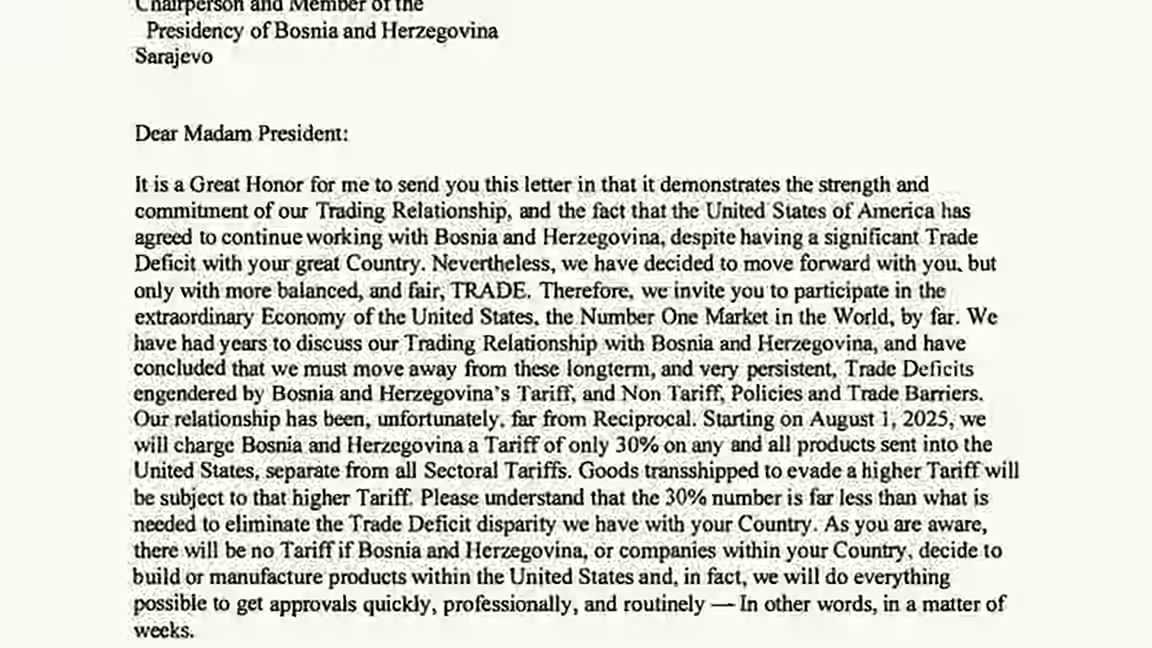
The plan imposed a minimum 10% tariff on imports from most countries beginning April 5, with higher rates for some major trading partners scheduled to start on April 9. India was listed at 27%, the European Union at 20% and Vietnam at 46%, according to India Today. China faced a new 34% rate under the announcement.
The exclusions did not mean all listed countries could trade with the United States without penalties. A US official cited by India Today said existing sanctions and tariffs already sharply restricted commerce with some of them. Treasury Secretary Scott Bessent said Russia was omitted because sanctions had reduced US-Russian trade to minimal levels. North Korea, Cuba and Belarus were likewise already subject to extensive restrictions.
Canada and Mexico were treated through a different set of measures. The United States had previously imposed a 25% tariff on imports from both countries, with a lower 10% rate for Canadian energy and potash. Goods qualifying under the United States-Mexico-Canada Agreement remained outside the new duties, although auto parts and other products were due to face additional levies.
Those distinctions explain why an absence from the April 2 chart was not equivalent to an exemption from US trade policy. Canada and Mexico already faced tariffs; the other omitted countries had trade constrained by sanctions or earlier restrictions.
Partners prepare responses
The day after the announcement, Canadian Prime Minister Mark Carney said Canada would apply 25% levies to certain vehicles imported from the United States. He described the relationship between the two countries as fundamentally changed. Mexico’s President Claudia Sheinbaum, by contrast, said her government would not retaliate in the same way.
The United Kingdom prepared a long list of US products that could be targeted if it chose to respond, while European leaders criticised the measures but had not yet announced the bloc’s formal plan in the supplied reporting. Vietnam’s foreign ministry said on April 4 that it regretted the US decision and would pursue discussions aimed at stable bilateral trade.
These were later reactions to the April 2 announcement, not positions all established on the event date.
Markets fall on April 3
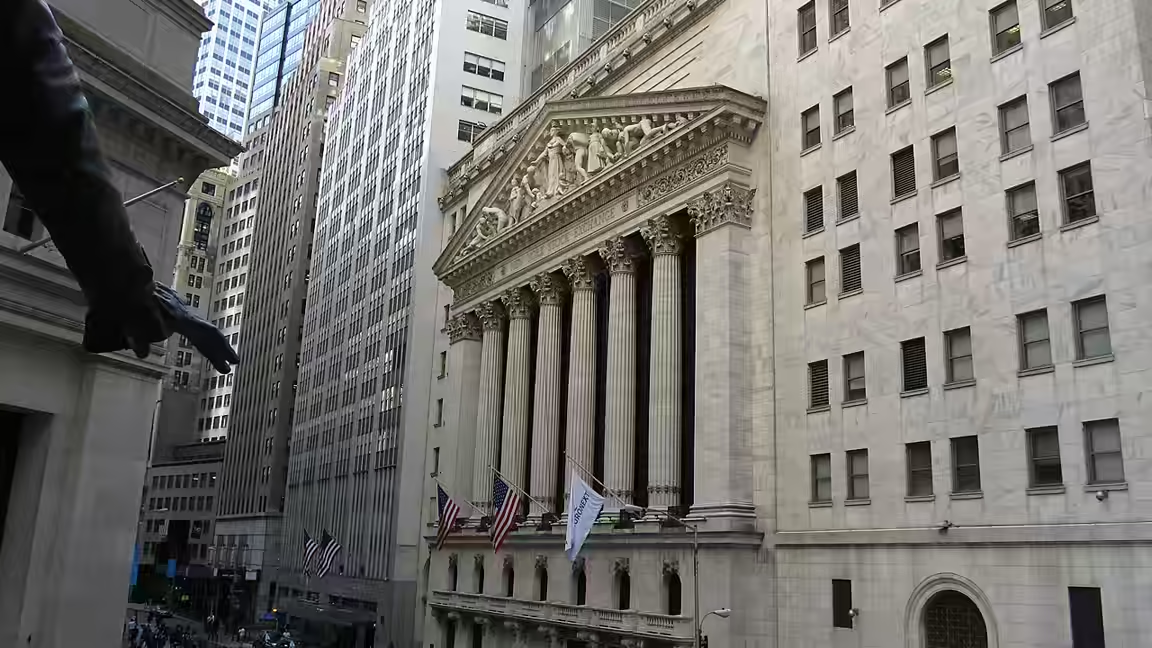
US stocks dropped sharply on Thursday, April 3, as investors assessed the potential effects on prices, trade and economic growth. The S&P 500 fell 4.8%, its worst session since the pandemic-driven turmoil of 2020. The Dow Jones Industrial Average lost 1,679 points, or 4%, and the Nasdaq Composite fell 6%.
Howard Silverblatt, a senior analyst at S&P Dow Jones Indices, estimated that as much as $2.01 trillion in US equity value disappeared during the sell-off. Smaller companies also suffered: the Russell 2000 declined 6.6% and moved more than 20% below its record.
Trump said the market decline was an expected part of a transition and predicted that stocks and the wider economy would ultimately boom. He argued that companies could avoid tariffs by producing goods in the United States and said he would consider negotiations if trading partners offered an exceptional deal.
International Monetary Fund managing director Kristalina Georgieva described the tariffs as a significant danger to the global outlook at a time of weak growth and urged Washington and its partners to avoid further damage. Her assessment was a warning about risk, not a declaration that a global recession had begun.
Political resistance also emerged after the event date. On April 3, Republican Senator Chuck Grassley and Democratic Senator Maria Cantwell introduced legislation that would require Congress to approve new tariffs within 60 days or end their enforcement. The supplied reporting said the proposal was unlikely to become law while Republicans controlled both chambers.
The April 2 decision therefore created different categories rather than a single universal tariff. Most countries entered the new baseline or higher-rate system; Canada and Mexico remained under separate measures; and heavily sanctioned states stayed outside the list because their trade was already limited. The immediate next-day consequences were visible in retaliatory planning, political opposition and the steepest US market losses in years.